

When you file for bankruptcy, the automatic stay stops creditors from pursuing collection efforts, like foreclosures or wage garnishments. However, this protection isn’t permanent. Creditors can request to lift the stay under specific circumstances. Here are the five main reasons why a court might allow it:
- Missed Payments: Falling behind on Chapter 13 repayment plans or secured debt payments like mortgages or car loans.
- Insufficient Collateral Protection: If the value of collateral (e.g., a car or home) drops or insurance lapses, creditors can argue their interests aren’t protected.
- No Insurance on Collateral: Failing to maintain required insurance on secured assets puts creditors at risk.
- Bad Faith Filing: Filing bankruptcy to delay creditors, without intent to repay debts, or repeated filings in a short time can lead to the stay being lifted.
- Non-Dischargeable Debts: Creditors for debts like child support, alimony, or recent taxes can request to proceed with collection efforts.
Understanding these scenarios can help you avoid losing the protections of the automatic stay. If you’re notified of a motion to lift the stay, act fast and consult an attorney to protect your rights.
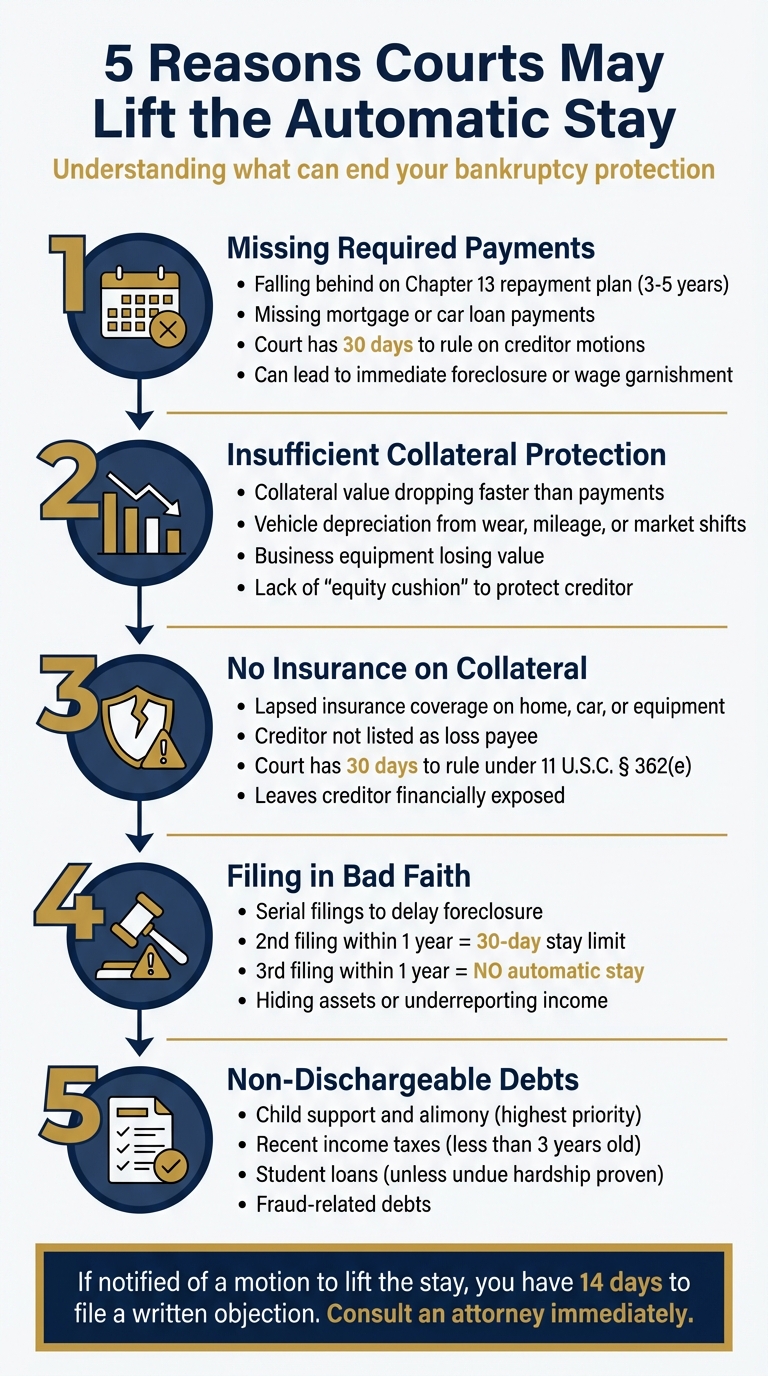
5 Reasons Courts Lift Automatic Stay in Bankruptcy
The Nuts and Bolts of a Lift Stay Motion
sbb-itb-d613a70
1. Missing Required Payments
Filing for Chapter 13 bankruptcy means committing to a court-approved repayment plan, which usually spans three to five years. This plan outlines the monthly payments you must make to a bankruptcy trustee. Falling behind on these payments can threaten the automatic stay that protects you from collection efforts, often prompting swift action from lenders.
If you miss payments on secured debts, like a mortgage or car loan, or fail to keep up with your Chapter 13 plan, your lender or trustee can take action. Lenders might file a Motion for Relief from the Automatic Stay, while trustees may move to dismiss your case. The bankruptcy court generally has 30 days to rule on these motions.
"After you’re late on a few mortgage payments, your lender can ask the court for permission to foreclose. The lender makes the request by filing a motion asking the court to lift the automatic stay that prohibits collections when you file for bankruptcy." – rqplaw.com
If the court approves a motion to lift the stay or dismisses your case, the automatic stay ends immediately. This allows creditors to resume foreclosure, wage garnishment, or other collection activities. Missing payments – whether it leads to a lender’s motion or a trustee’s dismissal – can severely weaken the protections offered during bankruptcy.
If you’re finding it hard to keep up with payments, reaching out to your trustee or filing a motion to adjust your repayment plan could help you avoid losing these critical protections.
2. Insufficient Protection for Creditor’s Collateral
When you file for bankruptcy, creditors with secured loans – like car lenders or mortgage holders – still retain a legal claim over their collateral. According to 11 U.S.C. § 362(d), a court may lift the automatic stay if a creditor proves there’s a "lack of adequate protection." This happens when the collateral’s value is dropping faster than the debtor’s payments after filing can keep up.
Take this example: if you miss car payments and your vehicle’s value decreases due to normal wear, high mileage, or market shifts, your lender might request to lift the stay. The same applies to business equipment, machinery, or tools that lose value through heavy use or poor maintenance.
Another critical factor is insurance. Proper insurance coverage is essential to safeguard the creditor’s interest. If required insurance lapses – especially when the creditor is listed as the loss payee – the collateral is at significant risk. In such cases, courts may schedule emergency hearings within days if creditors can show an immediate threat to their collateral.
"One of the strongest arguments for lifting the stay is that a secured creditor’s interests are not adequately protected. This is especially relevant when a secured asset (such as real estate or equipment) is losing value and the debtor is not making payments or maintaining insurance." – Tim Anzenberger, Attorney, Adams and Reese
Debtors can push back against these motions by offering adequate protection. This might include making regular cash payments to offset depreciation, showing an "equity cushion" (where the property’s value far exceeds the debt), staying current on post-petition payments, and ensuring required insurance is in place.
3. No Insurance on Collateral
When you pledge assets like your home, car, or business equipment as collateral for a loan, keeping those assets insured isn’t just a good idea – it’s a requirement. Insurance protects both you and your lender, especially in situations like bankruptcy.
If your insurance coverage lapses, creditors often act quickly. They may file a motion claiming their collateral lacks adequate protection. Why? Because without insurance, their financial risk skyrockets. For instance, if your house burns down or your car is totaled, the insurance payout serves as a replacement for the lost asset. Without that safety net, creditors are left vulnerable.
"Insurance coverage is an essential part of protecting collateral. Debtors are typically required to maintain insurance under the loan agreement. However, in bankruptcy, those obligations can lapse or be overlooked, leaving the creditor exposed." – Tatman Legal
Under 11 U.S.C. § 362(e), bankruptcy courts usually have 30 days to rule on a creditor’s Motion for Relief if insurance has lapsed. During this time, providing updated proof of insurance can help demonstrate adequate protection and potentially resolve the issue.
To avoid these complications, take proactive steps:
- Ensure your lender or finance company is listed as the loss payee on your insurance policy.
- Set up automatic payments to keep premiums current.
- If you’re struggling with costs, notify your attorney immediately to explore options and prevent a lapse.
Failing to maintain insurance not only puts your assets at risk but can also jeopardize your bankruptcy proceedings. Meeting all post-petition obligations, including insurance, is crucial for protecting both you and your creditors.
4. Filing Bankruptcy in Bad Faith
Courts take a firm stance against those who misuse the bankruptcy process. Filing bankruptcy in bad faith – whether to harass creditors, hide assets, or stall proceedings without a genuine intent to reorganize debts – is not tolerated.
One common red flag is serial filings. This happens when someone repeatedly files for bankruptcy to delay foreclosure or other collection efforts, only to have their cases dismissed for reasons like non-payment or failing to follow court rules. For instance, if a bankruptcy case was dismissed within the past year, any new filing limits the automatic stay (the protection against creditors) to just 30 days. A third filing within the same year eliminates the automatic stay altogether.
"Multiple filings in quick succession suggest that the filer is manipulating the bankruptcy system." – Cara O’Neill, Attorney, Nolo
Courts look at the bigger picture to decide if a bankruptcy filing is in bad faith. They examine actions like hiding assets, underreporting income, transferring property to friends or family, or using bankruptcy as a tactic to avoid paying a single large debt without addressing other financial issues. Other warning signs include skipping the 341 meeting of creditors, failing to submit required paperwork, or providing inaccurate financial details.
If the court determines bad faith, the consequences can be severe. Your case may be dismissed, the automatic stay lifted immediately, and you could even face federal fraud charges. To avoid this, it’s essential to show good faith by staying current on required payments, attending all hearings, keeping meticulous financial records, and working closely with your attorney. Maintaining good faith not only ensures compliance but also preserves the protections discussed in the next section.
5. Litigation for Non-Dischargeable Debts
Some debts stick around even after bankruptcy. These are known as non-dischargeable debts and include obligations like child support, alimony, recent income taxes, and student loans. Because these debts aren’t wiped out through bankruptcy, creditors holding them can ask the court to lift the automatic stay, allowing them to continue or start legal proceedings outside of the bankruptcy process.
Why does this happen? Creditors often need to confirm the exact amount owed or use specialized courts to collect these debts. For instance, Domestic Support Obligations (DSO) are treated as the highest priority under federal law and must be fully paid in Chapter 13 cases. The automatic stay doesn’t block actions like establishing paternity, modifying child custody, or collecting domestic support from non-estate property. Attorney Elaine M. Dowling explains:
"One common misconception is that if you believe your debt is not dischargeable in a bankruptcy, then somehow the automatic stay does not apply. Nowhere does Section 362 limit the automatic stay to nondischargeable claims".
Here’s a quick breakdown of how the automatic stay interacts with common non-dischargeable debts:
| Debt Type | Can It Be Discharged? | How the Stay Applies |
|---|---|---|
| Child Support / Alimony | No | Non-estate collections allowed; modifications can proceed |
| Recent Income Taxes | Generally no (if less than 3 years old) | IRS can audit or request returns but typically can’t issue new liens or seize property without court permission |
| Student Loans | No (unless "undue hardship" is proven) | Collections are paused, but lenders may seek court approval to continue litigation |
| Fraud-Related Debts | No | Creditors often request to lift the stay to pursue fraud litigation in state or federal court |
Some non-dischargeable debts, like fraud-related ones, can lead to more complicated legal situations. Creditors pursuing fraud claims may face challenges if a state court case is already underway. Restarting those proceedings in bankruptcy court can be inefficient and expensive. As attorney Cara O’Neill puts it:
"The bankruptcy judge might lift the stay to allow the creditor to litigate a fraud action… lawsuits are expensive, and it can be unfair to require them to incur the costs of starting over".
For fraud-related cases, creditors must pay a $188 filing fee and provide valid reasons to proceed, which could mean restarting litigation in bankruptcy court. This is why having skilled legal representation is critical to protecting your rights and assets.
If you’re notified of a motion to lift the stay, you have 14 days to file a written objection. Partnering with an attorney can help you craft a solid response and safeguard your financial recovery plan.
How Legal Representation Can Help Protect Your Home
When creditors move to lift the automatic stay in bankruptcy cases, having professional legal support can make all the difference. The clock starts ticking as soon as a creditor files a motion to lift the stay, and missing the response deadline could lead to default judgments that put your home at risk. Acting quickly and effectively is critical.
An experienced attorney can identify procedural mistakes that might invalidate the creditor’s motion. These could include errors like improper service, insufficient notice, or missing key documents such as loan agreements or payment histories. Creditors often base their motions on procedural or substantive grounds, but skilled legal counsel can craft defenses tailored to your situation, addressing these challenges head-on.
"A qualified bankruptcy attorney can make the strongest arguments possible for keeping the stay in force." – Michael Jay Berger, Attorney
Attorneys can argue that your property is essential for a successful financial reorganization, demonstrate the existence of an equity cushion, or negotiate alternative solutions to satisfy creditor concerns. Beyond responding to motions, legal professionals guide homeowners through the complexities of bankruptcy law, where navigating without representation can leave you at a serious disadvantage.
Foreclosure Defense Group offers skilled legal support for homeowners facing these challenges. Their services include bankruptcy assistance, foreclosure defense, and loan modification guidance, all aimed at protecting your home and rights during the bankruptcy process. They also provide free consultations to help you explore your options and develop a strategy to safeguard your property from creditor actions.
Conclusion
The automatic stay offers critical protection during bankruptcy, but it’s not a guarantee that lasts indefinitely. Missing mortgage payments, failing to maintain required insurance, or filing in bad faith can lead creditors to file motions to lift the stay. Once that happens, foreclosure or repossession can resume immediately. Understanding what can trigger the lifting of the automatic stay helps you take the necessary steps to safeguard your property.
Following bankruptcy terms is non-negotiable. For Chapter 13, you must stick to the repayment plan approved by the court for the full three to five years. Failure to do so can result in the stay being lifted. If you’ve filed for bankruptcy before, the rules become stricter: a second filing within one year limits the stay to just 30 days, while a third filing eliminates the stay entirely unless you can prove good faith with clear and convincing evidence. These rules highlight how crucial it is to comply with bankruptcy requirements to retain the protection of the stay.
Even when creditors challenge the automatic stay, there’s often room to defend against it. Courts frequently grant conditional relief, allowing the stay to remain in place under specific terms. This gives homeowners the chance to catch up on missed payments or resolve creditor concerns.
If you’re facing a motion to lift the stay, acting quickly is essential. An experienced attorney can help you identify flaws in the creditor’s motion, propose alternative solutions like adequate protection, or even convert your case to Chapter 13 to create a workable plan moving forward.
Foreclosure Defense Group offers free consultations to help homeowners explore their legal options. Their team can assist in crafting strategies to keep the automatic stay in place, ensuring your rights and your home are protected during financial hardships.
FAQs
How do I stop a motion to lift the automatic stay?
To counter a creditor’s motion to lift the automatic stay, you’ll need to file an objection with the bankruptcy court. In your objection, explain why the stay should remain in place. This might include disputing the creditor’s claims or showing that you’re actively working to resolve the issue, like catching up on overdue payments. Highlighting your compliance with bankruptcy requirements or detailing the hardship that lifting the stay would cause can also support your argument. It’s a smart move to consult a bankruptcy attorney to guide you through this process effectively.
What counts as “adequate protection” for a secured creditor?
When it comes to ensuring a secured creditor’s interests are safeguarded, the focus is on preventing any decline in the value of their collateral. This protection can take several forms, such as cash payments, regular periodic payments, additional or replacement liens, or other remedies. The goal is to guarantee that the creditor receives the indubitable equivalent of their stake in the property, as specified under bankruptcy law.
What happens to the automatic stay if I file bankruptcy again within a year?
If you file for bankruptcy again within a year, the automatic stay – which temporarily halts creditor actions – might be restricted or end sooner. In some cases, the court could even deny the stay altogether if it concludes that the filing was made in bad faith or as a tactic to delay creditors. The final decision largely hinges on the specifics of your situation and the type of bankruptcy you choose to file.
Related Blog Posts
- Bankruptcy vs. Loan Modification: Which Option Is Right for You?
- 7 Legal Rights Every Florida Homeowner Should Know
- How Chapter 13 Stops Foreclosure
- How Bankruptcy Impacts Foreclosure in Florida