

When you receive a foreclosure notice, it’s not the end – it’s the beginning of a legal process where your actions can shape the outcome. Foreclosures are rising, with over 26,000 cases initiated in January 2026 alone, leaving many families overwhelmed by legal deadlines, financial stress, and lender errors. Here’s the key takeaway: a personalized legal plan can help you navigate this process and protect your rights.
Key Points:
- Tailored Solutions: Every foreclosure is different. Strategies like loan modifications, forbearance, or bankruptcy depend on your unique financial situation.
- Legal Protections: Laws like the Telephone Consumer Protection Act (TCPA) and Real Estate Settlement Procedures Act (RESPA) can stop harassment, correct lender errors, and delay foreclosures.
- Act Quickly: Deadlines are tight – missing them can result in losing your home. Filing a loss mitigation application early or working with a legal team can buy you time.
Foreclosure Defense Group offers free consultations to evaluate your case, identify lender violations, and create a plan that fits your needs. Whether you want to keep your home or explore alternatives, taking action now can make all the difference.
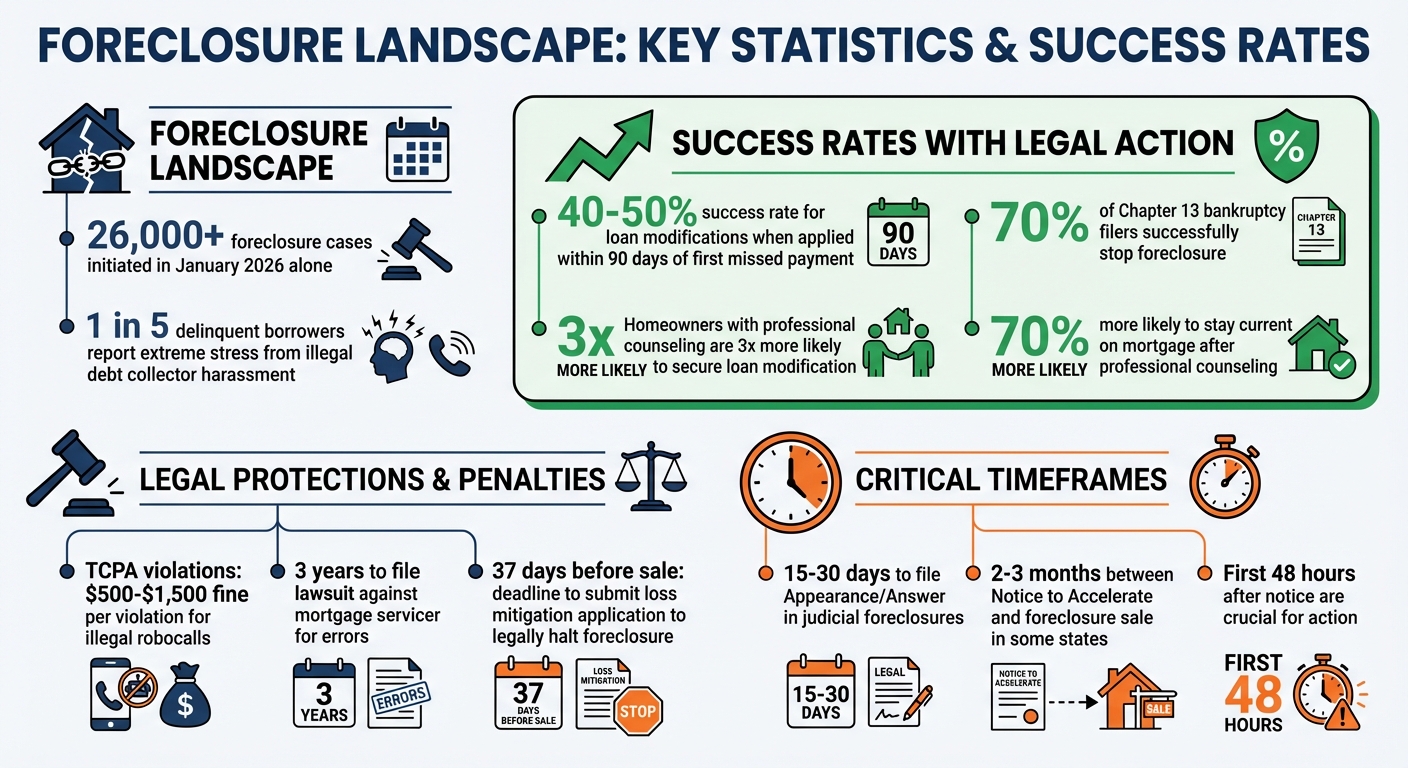
Foreclosure Defense Success Rates and Key Statistics
Save Your Home from Foreclosure
sbb-itb-d613a70
Common Foreclosure Challenges Homeowners Face
Foreclosures bring a host of challenges, each requiring a specific legal response. Every homeowner’s situation is different, which is why understanding these obstacles is key to crafting an effective defense.
Missed Payments and Financial Hardship
Unexpected financial troubles – like losing a job or a medical emergency – can quickly lead to missed mortgage payments. This often triggers foreclosure notices, such as a Notice of Default or Lis Pendens, which initiate a high-pressure legal process.
The stress only grows when debt collectors get involved. Around 1 in 5 delinquent borrowers report extreme stress due to illegal harassment from collectors. These tactics, including constant robocalls and pre-recorded messages, breach the Telephone Consumer Protection Act (TCPA). Companies violating the TCPA can face fines ranging from $500 to $1,500 per violation.
For homeowners, the solutions vary based on whether their financial hardship is temporary or permanent. This is why a tailored legal approach is so important – it addresses the specific financial challenges each person faces.
Lender Errors and Legal Complications
Mortgage servicer mistakes can make an already tough situation even worse. Common errors include misapplied payments, inflated charges, improper force-placed insurance, and "dual tracking", where a foreclosure continues while a loan modification application is being reviewed. These actions violate the Real Estate Settlement Procedures Act (RESPA) and can lead to inflated debts or foreclosures started in error.
"If you catch your mortgage servicer in a mistake, you have 3 years to bring a lawsuit against them if they are not responding to your requests".
To address these errors, homeowners must send a formal "Notice of Error" to their servicer, who is legally obligated to respond within a specific timeframe. Unfortunately, without proper documentation or legal guidance, many homeowners miss out on these protections, allowing servicer mistakes to speed up the foreclosure process.
This highlights the importance of thorough legal reviews to catch and address such errors.
Tight Deadlines in Judicial Foreclosures
In states with judicial foreclosure processes, court-imposed deadlines add another layer of pressure. Homeowners often have just 15 to 30 days to file an "Appearance" or "Answer" to a foreclosure complaint. Missing these deadlines can result in a default judgment, allowing the lender to move forward with a foreclosure sale without any input from the homeowner.
The legal jargon in these documents can be confusing, leaving many homeowners unaware of the urgency until it’s too late. Meanwhile, they must also explore loss mitigation options, adding to the complexity. Organizations like the Connecticut Housing Finance Authority (CHFA) offer counseling to help homeowners navigate these tight timelines.
These strict deadlines underline the need for legal strategies that prioritize speed and precision when time is of the essence.
Why Customized Legal Plans Work Better
A tailored legal plan directly addresses the complexities and nuances of foreclosure cases. Generic strategies often fail to account for the unique details that define each situation. Every foreclosure case is different – factors like the homeowner’s financial challenges and the state where the property is located play a huge role. A personalized legal approach considers these specifics, crafting a defense that aligns with the homeowner’s unique circumstances.
For instance, homeowners who apply for a loan modification within 90 days of their first missed payment see a success rate of around 40–50%. But not every homeowner has the same needs. Someone dealing with a temporary layoff might benefit from forbearance, while a person facing a permanent income reduction could require a loan modification. A generic approach often overlooks these distinctions, leading to ineffective solutions.
Addressing Individual Case Details
State laws vary widely, and this can have a significant impact on foreclosure timelines. In some jurisdictions, the time between a "Notice to Accelerate" and a foreclosure sale can be as short as 2–3 months. What works in Florida might not apply in Texas or California, where legal processes differ. A customized legal plan ensures compliance with local regulations while maximizing the time available to act.
Additionally, personalized strategies can uncover issues that generic plans miss, such as chain of ownership problems. For example, when mortgage companies sell trust deeds or lose documentation, it can create grounds to contest a foreclosure. Identifying these issues requires a thorough review of documents and legal expertise – something only a tailored approach can provide. By addressing these legal and procedural variations, customized strategies offer a more precise and effective defense.
Financial circumstances also demand individualized solutions. A Chapter 13 bankruptcy can stop foreclosures for about 70% of filers, allowing them to reorganize mortgage debt through a 3-to-5-year repayment plan. However, this option is only viable for homeowners with a steady income who want to keep their property. On the other hand, someone unable to afford their mortgage might turn to Chapter 7, which provides a temporary delay while they transition. Choosing the wrong option wastes valuable time and money, underscoring the importance of a tailored plan.
Protecting Homeowner Rights
Customized legal plans also make full use of consumer protection laws to defend homeowners. For example, lenders that violate the Telephone Consumer Protection Act (TCPA) with illegal robocalls can face penalties, which can be used to pause foreclosures or negotiate better terms. Similarly, errors by loan servicers, such as violations of the Fair Debt Collection Practices Act (FDCPA) or mistakes under the Fair Credit Reporting Act (FCRA), can create leverage that generic strategies often fail to identify. A personalized plan turns these legal protections into actionable tactics designed for your specific situation.
Timing is another critical factor in foreclosure defense. Under RESPA, submitting a complete loss mitigation application at least 37 days before a scheduled foreclosure sale legally halts the process. However, knowing exactly when and how to use this protection requires a clear understanding of your case’s timeline – something a generic checklist simply can’t provide. A customized plan ensures these protections are utilized effectively, safeguarding your rights when it matters most.
What Goes Into a Customized Legal Plan
Creating a customized legal plan starts with collecting detailed case information to identify potential defenses, detect errors, and create a strategy tailored to your specific foreclosure situation. This process typically begins with a structured intake system, where you complete questionnaires about your mortgage and financial situation. You’ll also need to provide key documents, such as your mortgage agreement, payment history, and any foreclosure notices. Legal service providers often review extensive documentation – sometimes exceeding 15 pages – during this initial stage.
Document Review and Case Analysis
An attorney will carefully examine your mortgage documents, payment records, and foreclosure notices to find possible defenses and discrepancies that could challenge the foreclosure. This phase often highlights issues like mortgage companies selling trust deeds or losing track of borrowers after transferring loan documents. The review also involves analyzing critical notices, such as distinguishing between a Notice of Default and a Lis Pendens, to identify deadlines and determine who is initiating the foreclosure. Some legal plans even include financial counseling – up to 10 hours – to address credit, budgeting, and debt concerns.
Building a Defense Strategy
Once the document review is complete, the next step is crafting a solid defense strategy. A customized plan equips you to actively participate in your defense. This might involve negotiating with your mortgage servicer, filing counterclaims if lender violations are uncovered, or exploring loss mitigation options like loan modifications. For example, if your lender violated the Fair Debt Collection Practices Act (FDCPA) through harassment or misleading practices, your attorney can use this as leverage to pause the foreclosure or negotiate better terms. Similarly, illegal robocalls that breach the Telephone Consumer Protection Act (TCPA) could result in penalties of $500 to $1,500 per violation, potentially turning lender misconduct into a bargaining tool. Timing is also crucial – submitting a complete loss mitigation application at least 37 days before a scheduled sale can legally halt the process under RESPA regulations.
Including Financial Relief Options
A well-rounded legal plan doesn’t just focus on defense; it also includes financial relief options tailored to your needs. These options typically fall into two categories: retention strategies (if you aim to keep your home) and liquidation strategies (if exiting the property is necessary). Retention options might involve loan modifications, which adjust your loan terms to make payments more manageable, or forbearance agreements, which temporarily pause or reduce payments during short-term hardships like illness or job loss. Repayment plans are another option, allowing you to catch up on missed payments by spreading the overdue amount across your monthly payments.
If staying in your home isn’t realistic, your plan might include alternatives like a short sale – selling the property for less than the mortgage balance with lender approval – or a deed-in-lieu of foreclosure, where you voluntarily transfer the title to avoid formal foreclosure proceedings. Depending on your situation, options like Chapter 13 bankruptcy, which reorganizes debt over 3 to 5 years, or a forbearance plan to cover a temporary income gap, can also be considered. Combining these financial relief measures with a strong defense ensures your legal approach protects your rights and aligns with your circumstances.
How Foreclosure Defense Group Creates Customized Legal Plans
Foreclosure Defense Group, under the leadership of founding attorney Austin N. Aaronson, Esq., takes a personalized approach to foreclosure cases. The process starts with a free telephone consultation, where the team reviews your mortgage situation and any active foreclosure proceedings. During this call, they gather essential details about your loan terms, payment history, and communications with your lender. A financial evaluation follows, analyzing your assets, liabilities, income, home value, and the practices of your mortgage servicer. They also review your credit history to determine which legal strategies – whether based on state law, federal law, bankruptcy code, or tax code – would best suit your case. This thorough assessment ensures your rights are protected and legal solutions are tailored to your unique needs. The initial review naturally transitions to one-on-one consultations that focus on your specific challenges.
Free Consultation for Personalized Advice
The free consultation is designed to provide clear and practical guidance. As outlined in the firm’s Foreclosure Intervention Program, "The purpose of this FREE CONSULTATION is for our professionals to gain an understanding of your individual situation in order to determine if we can help you. We will not waste your time or give you false hope". During this session, the team examines your mortgage status, identifies possible consumer law violations (such as TCPA or FDCPA breaches), and evaluates your financial profile to determine the best course of action.
Full Range of Legal Services
After the initial assessment, Foreclosure Defense Group crafts a legal plan using its wide array of services. The firm defends foreclosure cases by challenging the enforceability of the mortgage, creating leverage for negotiation. As they explain, "The creation of leverage for negotiation of a more satisfactory resolution, due to the likelihood of prolonged foreclosure litigation otherwise". Depending on your financial goals and circumstances, your plan may involve:
- Foreclosure defense to safeguard your property rights.
- Loan modification to adjust debt terms.
- Forbearance to temporarily suspend payments.
- Alternatives like deed-in-lieu or short sale options.
The firm also utilizes government programs, such as HAMP-related initiatives, to help you stay in your home. Throughout the process, they maintain transparent pricing, so you’re fully informed about the costs of your customized plan.
Custom Pricing Based on Your Case
Legal fees are structured around the complexity of your case, with a detailed breakdown provided during your free consultation. For example, if your plan includes Chapter 13 bankruptcy to reorganize mortgage debt, the firm can explain how a $12,000 arrearage could be converted into manageable monthly payments of about $200 over five years. They also investigate potential consumer law violations, which could result in financial settlements that help offset legal expenses. Since the initial consultation is free, you can explore your options without any upfront financial obligation.
Steps to Implement Your Customized Legal Plan
A well-thought-out plan only works when executed properly. Follow these steps to ensure your rights are protected and your strategy is effective.
Step 1: Schedule Your Initial Consultation
Start by reaching out to Foreclosure Defense Group for a free phone consultation. Before the call, gather important documents like your Notice of Default or Lis Pendens, recent pay stubs, the last two months of bank statements, and a brief hardship letter. It’s also crucial to identify the foreclosing law firm or trustee mentioned in the notice and note any deadlines for your response. Being prepared allows your legal team to quickly assess your situation and recommend the best course of action. At this stage, applying for loss mitigation early can significantly boost your chances of achieving a favorable outcome.
Step 2: Collaborate on Your Strategy
Once your consultation is scheduled, the next step is to work closely with your attorney to develop a personalized defense strategy. Together, you’ll review your financial situation and decide on the most suitable legal approach. Your attorney will explain how specific tools can be applied to your case. For instance, submitting a complete loss mitigation application at least 37 days before a scheduled sale legally obligates your mortgage servicer to pause the foreclosure process. Options to consider may include forbearance, loan modification, or even Chapter 13 bankruptcy. Throughout this phase, keep detailed records of all interactions with your lender for future reference.
Step 3: Execute the Plan with Legal Support
With a strategy in place, the focus shifts to execution. Your legal team will take the lead here. They’ll handle tasks like submitting formal hardship requests in clear, precise language, negotiating with the lender’s legal representatives, and filing necessary court documents if you’re in a judicial foreclosure state. If keeping your home isn’t an option, alternatives like short sales or deeds-in-lieu can also be explored. For those opting for Chapter 13 bankruptcy, the automatic stay will immediately halt any scheduled sale, giving you time to reorganize your debt. Additionally, the legal team will investigate potential violations of consumer protection laws, such as illegal robocalls under the Telephone Consumer Protection Act (TCPA), which can result in penalties ranging from $500 to $1,500 per violation.
Conclusion
Foreclosure can feel overwhelming, but there are options to fight back. A personalized legal strategy is essential because no two foreclosure cases are the same. Whether you’re dealing with missed payments, lender mistakes, or tight deadlines, a tailored approach ensures your specific needs are addressed. This might involve tools like loss mitigation applications, Chapter 13 bankruptcy, or defenses under consumer protection laws – all designed to help you regain control and protect your rights.
The statistics back this up. Homeowners who request loan modifications within 90 days of their first missed payment succeed 40–50% of the time. Those who work with professional counseling services are nearly three times more likely to secure a loan modification and 70% more likely to stay current on their mortgage afterward. Similarly, about 70% of Chapter 13 bankruptcy filers successfully stop foreclosure while reorganizing their mortgage debt. These results highlight the power of strategic, personalized intervention.
Foreclosure Defense Group takes this approach to the next level by combining detailed document analysis with effective financial relief strategies. Their custom plans provide immediate solutions, whether it’s identifying lender errors, pausing a sale, negotiating a loan modification, or restructuring debt. With their free consultation, you gain access to experienced attorneys who can craft a plan tailored to your situation, giving you the best chance to protect your home and future.
Acting fast is crucial. With foreclosure filings on the rise, the first 48 hours after receiving a notice can make all the difference. A personalized legal plan not only safeguards your rights but also turns a challenging situation into a chance to take back control. Don’t wait – timely action could be the key to securing your home and your financial stability.
FAQs
What should I do in the first 48 hours after a foreclosure notice?
After getting a foreclosure notice, it’s crucial to move fast to protect your rights. Start by carefully reviewing the notice to understand the deadlines and specific details involved. If you intend to contest the foreclosure, make sure to file your response without delay. For nonjudicial foreclosures, double-check that all notice requirements have been followed. It’s also wise to seek legal advice right away to explore potential options, such as loan modifications or even bankruptcy. Working with a skilled foreclosure defense attorney can guide you through these important steps and help you make informed decisions.
How can I tell if my mortgage servicer made errors I can challenge?
Review your mortgage statements and documents carefully to spot any discrepancies, like incorrect charges or payments applied to the wrong account. If something doesn’t look right, don’t hesitate to consult trustworthy resources or get legal advice to figure out your options for addressing the issue. Catching these errors early can safeguard your rights and increase the likelihood of resolving the problem effectively.
Which option fits me best: loan modification, forbearance, or bankruptcy?
Deciding whether to pursue loan modification, forbearance, or bankruptcy depends entirely on your financial circumstances and what you aim to achieve.
- Loan modification involves permanently changing the terms of your loan to make payments more manageable.
- Forbearance provides temporary relief from payments, which can be helpful if you anticipate recovering financially in the near future.
- Bankruptcy might halt foreclosure and offer debt relief, but it comes with long-term consequences that require careful consideration.
It’s a smart move to consult a foreclosure defense attorney who can help you determine the most suitable option for your situation.
Related Blog Posts
- 3 Ways to Stop Foreclosure in Florida
- How Attorneys Help Resolve Mortgage Disputes
- Foreclosure Defense: Preventing Costly Errors
- Debt Reduction Strategies for Foreclosure Defense